Beyond Institutions: How Sri Arunodayam’s Micro-Community is Building Families and Redefining Rural Rehabilitation
– By Iyyappan Subramaniyan
“No one is born an orphan.”
This simple truth lies at the heart of Sri Arunodayam’s work. Orphanhood is not an identity—it is the result of tragedy: loss, disability, poverty, abandonment, and social exclusion. In India, these forces intersect most starkly in rural communities, where access to healthcare, early intervention, and inclusive education remains limited, and, for children with disabilities, the consequences are often devastating.
Without timely rehabilitation and strong community support, many children are pushed to the margins—into long-term institutions, the streets, exploitative labour, or worse! What begins as personal tragedy soon becomes a systemic failure, perpetuating cycles of exclusion across generations.
The Hidden Gap in Rural Development
India has made notable progress in healthcare and social welfare. Yet rehabilitation—especially for differently-abled children in rural areas—remains one of the most neglected pillars of development.
Several realities underscore this gap:
- A significant proportion of India’s persons with disabilities live in rural areas, where specialist services are scarce or non-existent.
- Early childhood intervention, which is critical for cognitive, physical, and social development, is often delayed or absent.
- Families caring for children with disabilities face stigma, economic strain, and isolation, increasing the risk of abandonment or institutionalisation.
- Traditional care models frequently prioritise custodial care over long-term rehabilitation, life planning, and social integration.
As a result, disability care in India has become increasingly institutionalised—well-intentioned, yet often disconnected from families, communities, and the child’s future as an adult.
When in Doubt, Go Higher
When we began considering the establishment of a special school in a rural setting, we consciously chose to challenge this status quo. We turned to a metaphor from mountaineering: “When in doubt, go higher.”
For a climber, ascending provides perspective—clarity in difficult terrain. For child rehabilitation, it means rising above one-size-fits-all institutional models and asking more fundamental questions:
- What does dignity look like for a child with disabilities?
- What kind of environment fosters not just survival, but belonging?
- How do we prepare children not merely to be cared for, but to live meaningful adult lives?
At Sri Arunodayam, going “higher” meant reimagining care itself.
Why Rural Rehabilitation Matters
Our work in Ramasamudram village reflects a much larger national challenge in disability and rehabilitation services.
Nearly 65% of India’s population lives in rural areas, yet access to rehabilitation professionals remains severely limited. In many regions, there may be one physiotherapist for every 50,000 people, compared to global norms of around 1:2,000. Families are often forced to travel hundreds of kilometres for basic therapy, imposing immense financial and emotional burdens.[1]
Only a small portion of rehabilitation services in India reach rural populations, with most facilities concentrated in urban and tier-1 cities. Even when services exist, rural health infrastructure frequently lacks basic accessibility—from ramps to assistive devices—making routine care difficult for persons with disabilities. Awareness of disability rights, entitlements, and government schemes is also limited, compounding exclusion.[2] [3]
Collectively, these gaps make rehabilitation—particularly for intellectual and developmental disabilities—one of the most underserved areas of rural health and education in India.
A Rural Gap Turns into a Hope-filled Solution
It was within this context that Sri Arunodayam established its Special School in Ramasamudram village, Pallipattu Taluk. Before this initiative, no specialised school or rehabilitation centre existed within a 150-kilometre radius. Children with intellectual disabilities and developmental delays had no access to early intervention, therapeutic education, or structured life planning close to home.
But this school was never envisioned as just another institution.
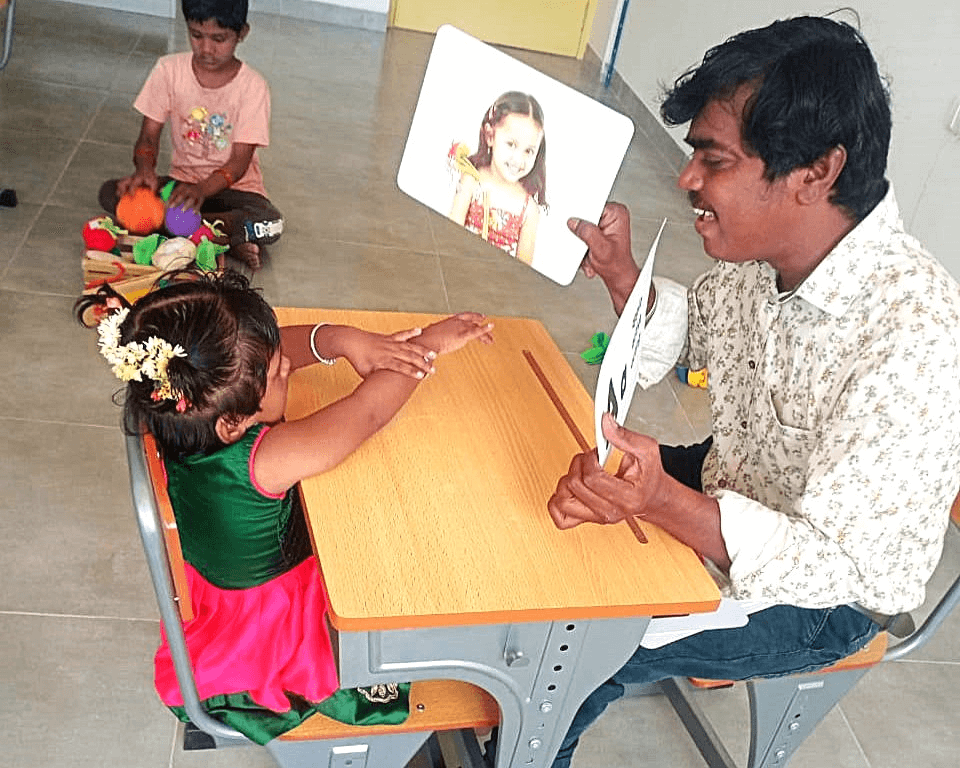
What makes it distinctive is not its infrastructure alone, but the rehabilitation ecosystem built around each child. The focus is holistic and intentional:
- Early intervention support tailored to each child, working closely with their family.
- Learning spaces that support thinking, movement, and social skills, designed to reflect everyday family and village life.
- Active involvement of families and the community in a child’s overall development.
- Individualised life planning with families to support a smooth transition into adulthood.
In doing so, the school enables families to remain connected, rather than being driven apart by disability or exclusion.
From Institution to Ecosystem
At the core of Sri Arunodayam’s approach lies the micro-community model.
Rather than functioning as a conventional special school, we built a community-based ecosystem rooted in relationships, shared responsibility, and long-term vision. The premise is simple, yet transformative: children do not thrive in isolation; they thrive in connection.
Here, care extends beyond schooling. Children are embedded within a supportive network that includes trained rehabilitation therapists (caregivers, educators, physiotherapists, and medical staff), life-skills planning, engagement with families and community, and deep integration with village life. Children are not viewed as beneficiaries, but as people with rights and a future—who will grow into adulthood with agency and purpose.
Why the Micro-Community Model Matters
Our approach aligns closely with what both research and lived experience consistently show:
- The quality-of-care matters more than the size or sophistication of buildings.[4]
- Children raised in family-like, community-connected environments experience better emotional, social, and developmental outcomes.[5]
- Rehabilitation is most effective when it is continuous, personalised, and embedded in daily life—not delivered as an occasional intervention.[6]
- Rural development becomes truly sustainable only when vulnerable populations are included, not segregated.[7]
By anchoring rehabilitation within the village, the micro-community model strengthens not only children but also entire families and the community itself—building awareness, generating livelihoods, and fostering shared ownership of care.
A Model with National Relevance
The transformation unfolding in Ramasamudram is more than a local success; it offers a blueprint for how we can rethink disability care, child welfare, and rural development.
This is not about expanding institutions and infrastructure. It is about recreating belonging—through ecosystems of care that honour individual and family dignity, plan for adulthood, and recognise the inherent value of every life. As India moves toward more inclusive, rights-based policies, the micro-community model presents a practical, scalable alternative—one that can inform government programmes, civil society initiatives, and rural development planning across the country.
We hope that what has taken root in Ramasamudram village—and in the work of other nonprofits that believe in the micro-community approach—does not remain an exception, but grows into a movement. Because no child is born an orphan, and no child should grow up without identity, purpose, or a place to belong.
References
[1] Challenges in Disability Rehabilitation and Inclusion in India – https://psychology.town/disability-rehabilitation/challenges-disability-rehabilitation-inclusion-india/ Psychology.Town.
A study on legal rights of persons with disabilities in India – https://ijcrt.org/papers/IJCRT2101603.pdf Ijcrt.org.
[2] National policy for persons with disabilities – https://www.disabilityindia.co.in/national-policy-for-persons-with-disabilities/. Disability India Network.
[3] Special Educators in the framework for inclusion in education. https://www.barandbench.com/columns/special-educators-framework-inclusion-education. Bar & Bench.
[4] Ethical Framework to Address Barriers to Healthcare for People with Disabilities in India. https://pmc.ncbi.nlm.nih.gov/articles/PMC9853476/. PubMed Central.
[5] Does Family Matter? The Well-Being of Children Growing Up in Institutions, Foster Care and Adoption. https://bettercarenetwork.org/library/particular-threats-to-childrens-care-and-protection/effects-of-institutional-care/does-family-matter-the-well-being-of-children-growing-up-in-institutions-foster-care-and-adoption. Better Care Network.
India’s move from institutional to family-based childcare gains momentum. https://www.business-standard.com/india-news/india-s-move-from-institutional-to-family-based-childcare-gains-momentum-125030900246_1.html. Business Standard.
[6] Evidence for the effectiveness of rehabilitation-in-the-community programmes. https://pubmed.ncbi.nlm.nih.gov/18540238/. PubMed.
[7] Paul, N., et al. (2019). A comprehensive study of community-based inclusion and rehabilitation in panchayats of North India. Indian Journal of Occupational Therapy, 51(3), 77–85. https://cordindia.in/wp-content/uploads/2023/08/IndianJOccupTher_2019_51_3_77_267478-1.pdf
Summary
No child is born an orphan — tragedy and exclusion create that reality. At Sri Arunodayam, we believe rescue is only the beginning; children with disabilities deserve identity, belonging, and a purposeful future. Moving beyond outdated institutional models, we chose to “go higher” by creating a micro-community in Ramasamudram village — an ecosystem where children are not just cared for, but truly belong, with structured support and life plans guiding them into adulthood. Because it’s not the infrastructure that transforms a child’s life — it’s the quality of care.
Tags
Orphan care in India
Children with disabilities in India
Inclusive child care models
Micro-community model for orphans
Rehabilitation for abandoned children
Disability care NGOs in India
Child Protection India
Alternative to institutional orphanages
Rural child development initiatives
Transforming institutional care in India
Life planning for differently-abled children
Inclusive ecosystem for abandoned children